By the MuskCasa Product & Engineering Team · Last reviewed: August 25, 2026 · Manufacturer-verified data
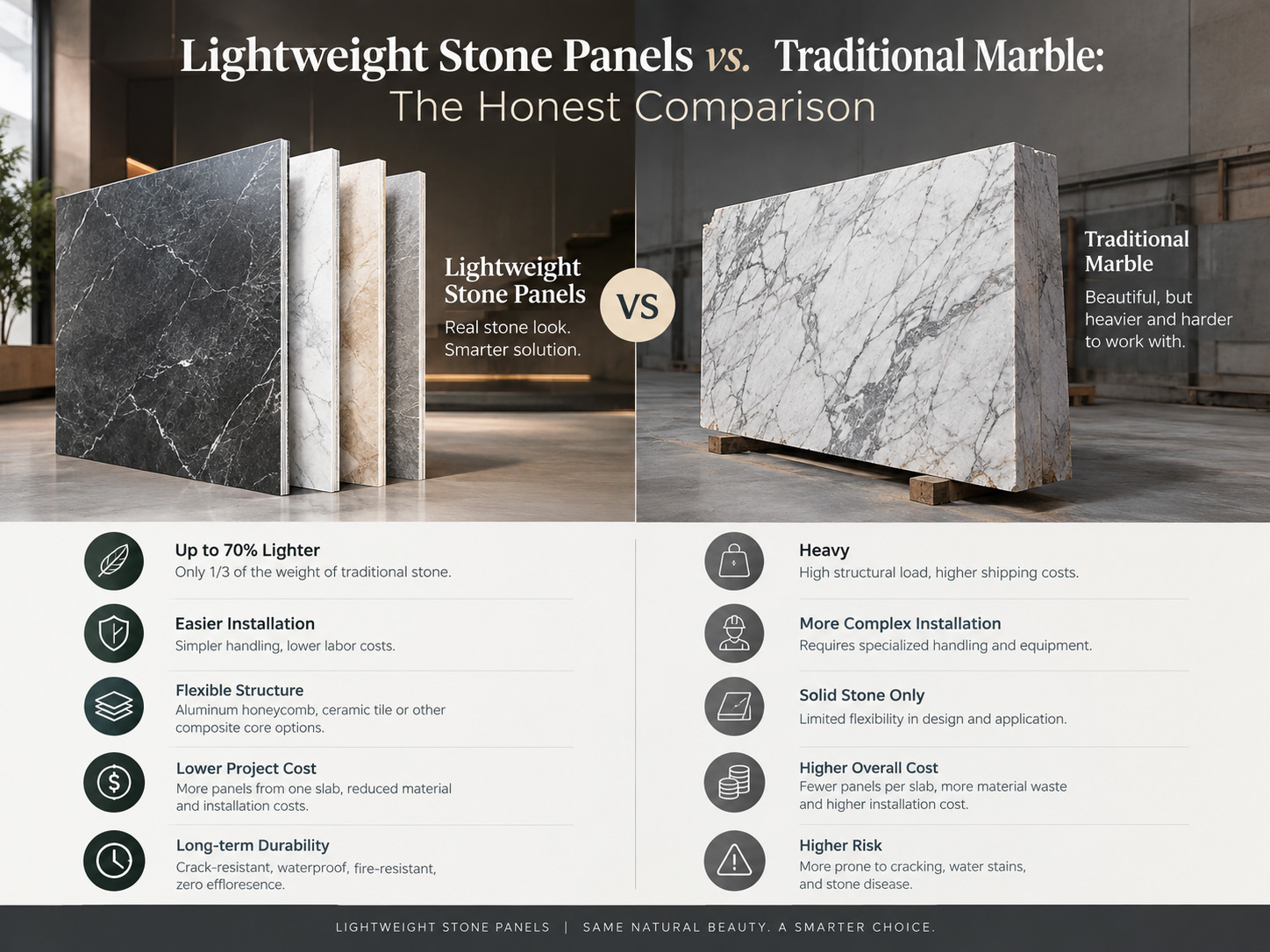
Quick Answer: For most residential and commercial projects, a lightweight stone panel outperforms traditional marble: it is up to 70% lighter, up to ~2× the flexural strength (18.1 MPa, SGS-tested), installs with 70–75% less labor, and ships with up to 95% lower transport emissions. The main trade-off is service life (30–50 years vs 50–100+ for solid stone) — rarely decisive for typical fit-outs.
Key Takeaways – Weight: panels are up to 70% lighter, with three cores at 1/2, 1/3, and 1/4 of natural stone weight; structural load drops ~90%. – Strength: flexural strength up to 18.1 MPa (sintered config ≈ 2× natural stone); mesh reinforcement resists crack propagation. – Cost & speed: 70–75% less installation labor (JMS Decor, 2025); material waste 3–5% vs 15–25% for traditional stone. – Honest caveat: over a 100-year horizon, solid stone can outlast a 30–50-year composite — but the carbon and cost advantage still favors panels for most builds.
Lightweight Stone Panel vs. Natural Stone: Quick Comparison
| Metric | Natural stone (full slab) | Lightweight stone panel | Source |
| Weight | 100% (baseline) | Up to 70% lighter (1/2, 1/3, or 1/4 by core type) | MuskCasa technical data |
| Flexural strength | Baseline | Up to 18.1 MPa (sintered: ~2× natural) | MuskCasa SGS-tested data |
| Max format / joints | Limited formats, many joints | Up to 1800 × 3500 mm, ~90% fewer joints | MuskCasa technical data |
| Service life | 50–100+ years | 30–50 years (correct installation) | MuskCasa data / industry practice |
| Reusability | Low | High (demountable dry-hung systems) | MuskCasa technical data |
Choose marble, and you buy beauty. Choose a lightweight composite stone panel, and you buy beauty plus engineering. But is the trade-off real? We compared the two side by side across the criteria that actually decide construction projects: weight, strength, installation, cost, and sustainability.
The Headline Numbers
| Criterion | Traditional Marble Slab | MuskCasa Lightweight Stone Panel |
| Weight vs. full slab | 100% | Up to 70% lighter (aluminum honeycomb: ~1/3) |
| Flexural strength | Baseline | Up to 18.1 MPa (SGS-tested) |
| Surface material | Full-thickness natural stone | Genuine 6 mm natural marble |
| Max format | Limited by slab weight | Up to 1800 × 3500 mm |
| Joints in full-height wall | Many | Reduced by up to 90% |
| Designed service life | 50–100+ years | 30–50 years (correct installation) |
| Reusability | Low | High (demountable dry-hung systems) |
(Product data source: MuskCasa technical specifications; natural-stone lifetime figures per common industry practice.)
1. Weight: The Defining Difference
Solid marble is heavy — roughly 12–20 lb per sq ft for full-thickness slabs, while thin composite panels weigh as little as 1.5–2.8 lb per sq ft (JMS Decor, 2025). That is around 90% less structural load.
Why this matters:
- Structures: Thinner, lighter cladding means less steel, less concrete, and simpler foundations.
- Shipping: More square footage per container. Transport accounts for a significant share of stone’s carbon footprint — roughly 10–15 kg CO₂e/m² when shipped more than 500 km (International Stone Federation study, 2023). Thin composite stone brings transport emissions down to roughly 2–3 kg CO₂e/m² (Coloria Group LCA, 2025).
- Handling: Panels at 15–31 kg/m² can be maneuvered by hand on site with proper lifting aids, rather than requiring cranes for every slab.
MuskCasa’s three composite types weigh 1/2, 1/3, and 1/4 of natural stone respectively (sintered, aluminum honeycomb, polypropylene honeycomb).
2. Strength: Composite Beats Solid Where It Counts
It sounds counterintuitive, but a well-engineered composite can outperform monolithic stone in the metrics that prevent failures:
- Flexural strength up to 18.1 MPa — for the sintered composite, this is roughly 2× the flexural strength of natural stone (MuskCasa data).
- Crack resistance: The embedded reinforcement structural mesh distributes localized stress, so point loads and thermal movement are far less likely to propagate cracks.
- Impact resistance: The bonded multi-layer construction absorbs impact better than a brittle monolithic slab.
- Water absorption: The 5-layer epoxy-sealed structure lowers water absorption, improving moisture resistance in bathrooms, kitchens, and exterior applications.
The honest caveat: over a very long horizon (50–100+ years), properly maintained solid stone can outlast a 30–50-year composite panel. For the vast majority of residential and commercial fit-outs, however, 30–50 years exceeds the practical life of the building envelope itself.
3. Installation: Speed and Safety
Solid stone installation is slow, specialized, and risky:
- Heavy slabs need cranes or multi-person crews.
- Cutting and handling full-thickness stone produces more waste and more on-site injuries.
- Industry analyses report 70–75% less installation labor time and around 75% lower labor cost for thin stone systems vs. traditional (JMS Decor, 2025; Coloria Group, 2025).
Lightweight panels support three installation methods:
- Full-spread adhesive — seamless, monolithic-looking floors and walls.
- Mechanical point fixing — adjustable anchors for interior walls.
- Dry-hung system — L-shaped galvanized brackets and vertical/horizontal rails, engineered for high-rise facades.
The dry-hung system is a game-changer: panels are mechanically fixed and fully demountable, meaning they can be removed and reused rather than demolished.
4. Cost: Up Front and Over Time
Lightweight panels usually cost less per installed square meter because:
- Lower shipping cost per m² (up to 75% lower per pallet in some comparisons — Translucent Stones / Coloria Group cost study, 2025).
- Faster installation cuts labor hours.
- Less structural reinforcement required.
- Material waste of thin-stone systems is roughly 3–5% versus 15–25% for traditional stone — about 80% less landfill waste (JMS Decor, 2025).
One indicative 10-year lifecycle comparison for a 2,000 sq ft application put thin-panel cladding at roughly USD 61,300 versus USD 147,000 for natural stone (Coloria Group, “Comprehensive Cost Comparison,” 2025). Note that LCA numbers are material- and project-specific — always request a quote tailored to your scope.
5. Sustainability: The Carbon Case
Buildings account for about 40% of global energy-related emissions (World Economic Forum, September 2024), and material choices matter more than ever under LEED and BREEAM regimes.
- Transport: Up to 95% lower transport emissions for thin panels (Coloria Group, 2025).
- Embodied carbon: Flexible thin-stone systems report total embodied carbon of roughly 15–20 kg CO₂e/m² — less than half of natural stone’s extraction-plus-processing footprint of 35–45 kg CO₂e/m² (International Stone Federation study, 2023; Coloria Group LCA, 2025).
- Circularity: Demountable dry-hung panels are designed for reuse and recycling, supporting material recovery at end of life.
Honesty note: carbon advantages narrow over a 100-year horizon if a composite requires replacement while natural stone does not. Disclose this in any sustainability reporting (per Coloria Group’s own 100-year caveat).
6. Aesthetics: Can You Tell the Difference?
The surface of a MuskCasa panel is real marble — Calacatta, Carrara, Volakas, Travertine, Onyx, and dozens more, in white, grey, beige, and dramatic tones like Cartier Black and Blue Galaxy. Because the visible layer is genuine stone, the veining, depth, and light reflection are indistinguishable from full-thickness marble.
Where composite panels actually exceed traditional stone is format: panels up to 1800 × 3500 mm create full-height, near-seamless surfaces with up to 90% fewer joints — a look impossible to achieve with conventional small slabs.
Which Should You Choose?
Choose traditional solid marble if: you need maximum material thickness, want a 100-year-plus institutional lifespan, or value monolithic stone weight for its own sake.
Choose a lightweight stone panel if: you want authentic stone aesthetics with lower cost, faster installation, reduced structural load, better logistics, and a sustainability story — or if your project involves facades, high-rise cladding, renovations, or demountable construction.
FAQ
Is a lightweight stone panel durable enough for floors? Yes. The sintered composite variant (6 mm marble + 6 mm ceramic) is designed for flooring with abrasion resistance up to 22/m³ and flexural strength up to 18.1 MPa.
Will the marble surface delaminate? The 5-layer structure uses high-performance epoxy adhesives plus a reinforcement mesh; panels are factory-bonded under controlled conditions and SGS-tested for material performance.
Is composite marble “cheap-looking”? No — the surface is genuine quarried marble. The composite is invisible in the finished installation.
Can lightweight panels be installed over existing tiles? Yes, with proper surface preparation (mechanical abrasion, moisture checks, and crack-isolation membranes where needed).
Conclusion
Traditional marble remains the reference point for timeless luxury. But when you weigh the certified numbers — 70% less weight, 2× flexural strength, 90% fewer joints, and a fraction of the transport emissions — lightweight stone panels are the rational evolution of the same material. For most projects in 2026, the smarter luxury is the lighter one.
About the Manufacturer: MuskCasa
MuskCasa (www.muskcasa-stonepanel.com) is a factory-direct manufacturer and global supplier of lightweight natural stone panels. We own and operate the production facility, giving us direct control over quality at every stage — from stone selection and 5-layer composite lamination to final inspection before shipment.
- Factory direct — competitive pricing and direct technical support straight from the producer, with no trading intermediaries.
- Strict quality control — every panel is inspected before dispatch.
- SGS tested — material performance and quality validated by SGS.
- Global shipping — reliable export logistics worldwide (sea, air, express).
- Project support — end-to-end assistance from design proposal to installation, with a dedicated project manager.
- OEM & ODM — custom sizes, surfaces, colors, and packaging; lead times of 15–35 days with expedited options.
- Sample box available — physical sample kits so specifiers can verify material quality before ordering.
Sources & Data Verification
First-party (manufacturer) data — MuskCasa’s SGS-tested technical specifications: up to 70% weight reduction; 1/2, 1/3, 1/4 weight ratios; flexural strength up to 18.1 MPa; abrasion resistance up to 22/m³; service life 30–50 years; formats up to 1800 × 3500 mm.
Third-party data (verified August 2026): – World Economic Forum (September 2024) — buildings account for ~40% of global energy-related emissions – International Stone Federation (2023), via Coloria Group LCA — natural stone extraction + processing ≈ 35–45 kg CO₂e/m²; +10–15 kg CO₂e/m² beyond 500 km transport – Coloria Group (2025), LCA — thin-stone transport emissions 2–3 kg CO₂e/m² (up to 95% lower); flexible stone embodied carbon 15–20 kg CO₂e/m²; 10-year cost example USD 61,300 vs USD 147,000 (2,000 sq ft) – JMS Decor (2025) — labor time −70–75%, labor cost −75%, waste 3–5% vs 15–25%, structural load ~90% lower – Translucent Stones (2025), via Coloria Group cost study — shipping cost −75% per pallet for artificial/composite stone
Figures last verified on August 25, 2026. LCA values are material- and project-specific; always confirm with your supplier’s documentation.
Related Reading (Topic Cluster)
- What Is a Lightweight Stone Panel? The Complete 2026 Guide
- Why Lightweight Stone Panels Are Up to 70% Lighter: The Engineering Explained
- Aluminum Honeycomb Stone Panels: The Engineering Solution for Modern Facades
How to Install Lightweight Stone Panels: A Step-by-Step Guide
No responses yet