By the MuskCasa Product & Engineering Team · Last reviewed: August 25, 2026 · Manufacturer-verified data
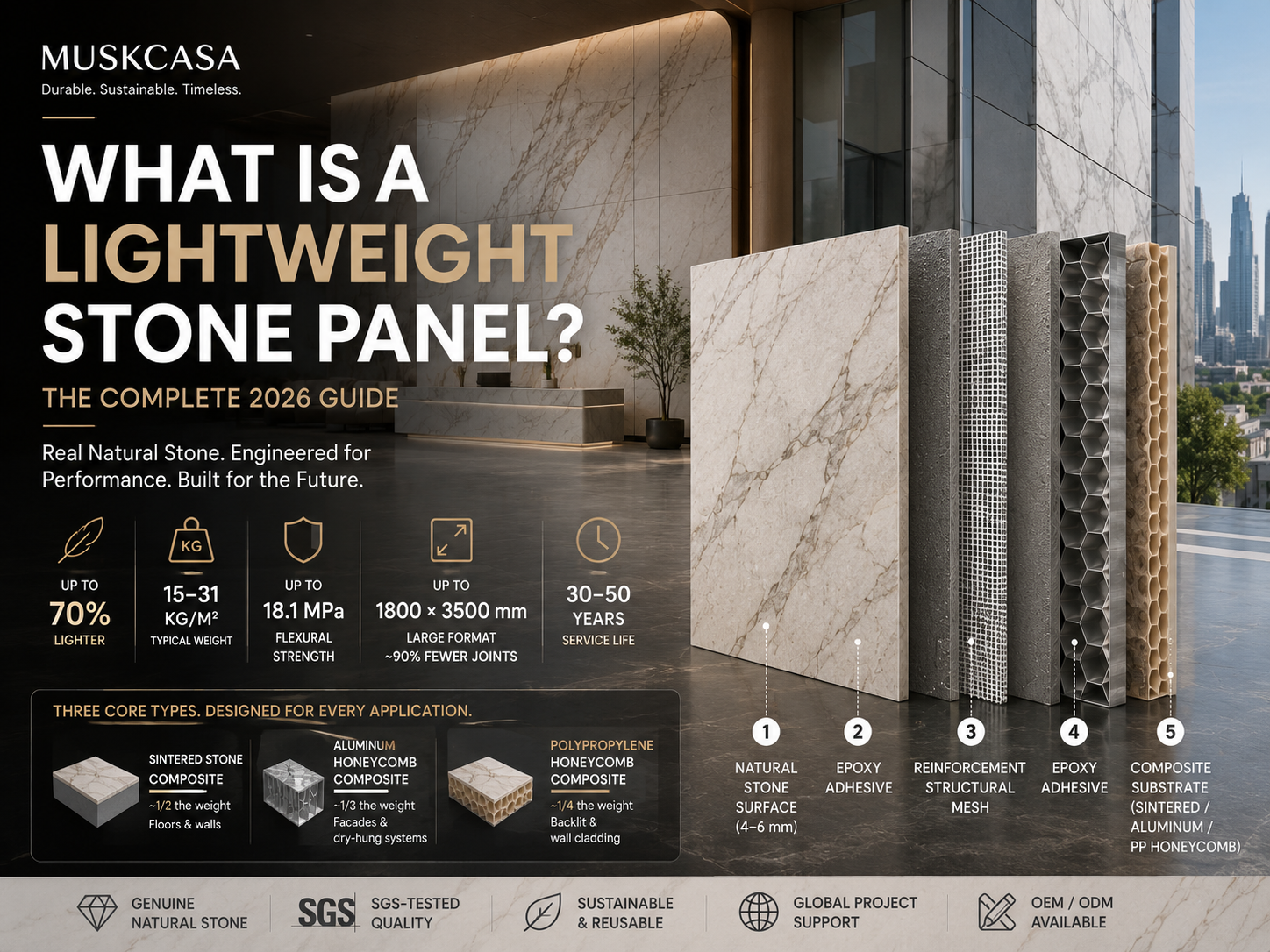
Quick Answer: A lightweight stone panel is a genuine natural-stone surface (4–6 mm marble or quartzite) permanently bonded to an engineered composite core — sintered ceramic, aluminum honeycomb, or polypropylene honeycomb — through a 5-layer construction. It delivers the look and aging of real stone at up to 70% lower weight, with flexural strength up to 18.1 MPa and panels up to 1800 × 3500 mm that cut visible joints by up to 90%.
Key Takeaways – Lightweight stone panels keep a real 6 mm natural stone face; only the backing is composite. – Three core types serve different jobs: sintered (1/2 weight; floors & walls), aluminum honeycomb (1/3 weight; demountable facades), polypropylene honeycomb (1/4 weight; backlit panels). – The 5-layer epoxy + mesh construction raises flexural strength to up to 18.1 MPa (SGS-tested) and lowers water absorption. – Market outlook: the ultra-thin stone veneer market is forecast to grow from USD 3.60B (2024) to USD 6.0B by 2035 (WiseGuy Reports, 2025).
Lightweight Stone Panel vs. Natural Stone: Quick Comparison
| Metric | Natural stone (full slab) | Lightweight stone panel | Source |
| Weight | 100% (baseline) | Up to 70% lighter (1/2, 1/3, or 1/4 by core type) | MuskCasa technical data |
| Flexural strength | Baseline | Up to 18.1 MPa (sintered: ~2× natural) | MuskCasa SGS-tested data |
| Max format / joints | Limited formats, many joints | Up to 1800 × 3500 mm, ~90% fewer joints | MuskCasa technical data |
| Service life | 50–100+ years | 30–50 years (correct installation) | MuskCasa data / industry practice |
| Reusability | Low | High (demountable dry-hung systems) | MuskCasa technical data |
Natural marble has always been the gold standard for luxury interiors — but it comes with a heavy price, both literally and figuratively. Enter the lightweight stone panel: a genuine natural stone surface bonded to a high-performance composite core that delivers the look of quarried marble at a fraction of the weight.
In this guide, we break down what lightweight stone panels are, how they are engineered, the three main composite types, and why the global market is shifting toward them.
What Is a Lightweight Stone Panel?
A lightweight stone panel is a building material made of a genuine natural stone surface layer (typically 4–6 mm of real marble or quartzite) fused to an engineered composite substrate. The result is a panel that looks, feels, and ages like solid stone — but weighs dramatically less and offers superior structural performance.
MuskCasa’s lightweight stone panels use a five-layer construction:
- Natural stone surface layer (6 mm real marble)
- High-performance epoxy adhesive
- Reinforcement structural mesh
- High-performance epoxy adhesive
- Composite substrate (sintered ceramic, aluminum honeycomb, or polypropylene honeycomb)
This layered architecture is what separates a lightweight stone panel from a simple stone tile. The reinforcement mesh distributes stress across the panel, reducing the risk of cracks while allowing much larger formats than traditional stone.
Technical data: According to MuskCasa’s SGS-tested specifications, the panels achieve a flexural (bending) strength of up to 18.1 MPa and an abrasion resistance index of up to 22/m³, with a designed service life of 30–50 years under correct installation and use.
The Three Types of Lightweight Stone Panels
Not all composite cores are equal. Depending on the application, you can choose between three substrate technologies:
| Type | Composite core | Weight vs. natural stone | Typical weight | Best for |
| Sintered Stone Composite | 6 mm ceramic | ~1/2 | 30–31 kg/m² | Flooring, mechanically fixed walls |
| Aluminum Honeycomb Composite | 15 mm aluminum honeycomb | ~1/3 | 20–21 kg/m² | Point-fixed walls, dry-hung cladding, facades |
| Polypropylene Honeycomb Composite | 15 mm polypropylene honeycomb | ~1/4 | 15–16 kg/m² | Backlit luxury applications, wall cladding |
(Data source: MuskCasa lightweight stone panel technical specifications)
Sintered Stone Composite
Combines a 6 mm natural stone face with a 6 mm ceramic base. It weighs about half of solid natural stone while delivering double the flexural strength. This is the workhorse option for floors and interior walls.
Aluminum Honeycomb Composite
The aluminum honeycomb core is designed for demountable, reusable dry-hung installation — a critical feature for sustainable architecture where materials should be recoverable at end of life.
Polypropylene Honeycomb Composite
The lightest option at roughly one-quarter the weight of natural stone. Its semi-translucent quality enables striking backlit stone applications where light passes through the thin marble veneer.
Why Weight Matters in Construction
Weight is not just a logistics headache — it drives cost and carbon across the entire supply chain:
- Structure: Lighter cladding reduces the structural load on frames, beams, and foundations, which can lower the steel and concrete required.
- Transport: A truck carrying lightweight panels moves more surface area per trip. Industry analyses (Coloria Group, 2025 LCA) report that thin composite stone can cut transport emissions by up to 95% versus full slabs, because one truck carries 8,000+ sq ft of paneling compared to 400–500 sq ft for solid slabs.
- Installation: Fewer workers and less heavy equipment are needed on site. Flexible thin-stone systems have been reported to reduce installation labor time by 70–75% (JMS Decor, 2025).
MuskCasa’s own panels are up to 70% lighter than traditional full-thickness marble slabs (per manufacturer technical data).
Market Context: A Category on the Rise
The shift to lightweight and thin stone is backed by hard numbers:
- The global ultra-thin stone veneer market was valued at USD 3.60 billion in 2024 and is projected to reach USD 6.0 billion by 2035, a CAGR of 4.9% (WiseGuy Reports, “Global Ultra Thin Stone Veneer Market Research Report – Forecast to 2035,” 2025).
- The thin stone panel market is forecast to grow from USD 2.15 billion (2024) to USD 4.24 billion (2033), CAGR 6.9% (DataIntelo / GrowthMarketReports, “Thin Stone Panel Market Research Report 2033,” 2024/2025).
- The flexible stone market — the fastest-growing subsegment, enabling curved and retrofit applications — is growing at 9.4% CAGR, from USD 538.2 million (2024) to USD 1.12 billion by 2032 (24ChemicalResearch, “Global Flexible Stone Market Insights, Forecast to 2032,” 2025).
Analysts consistently identify lightweight panels as a growth driver because they reduce structural load, transport emissions, and on-site labor — the three biggest cost centers in stone construction.
Applications of Lightweight Stone Panels
Because they are strong yet light, these panels unlock applications that traditional stone struggles with:
- Luxury villas: full-height marble feature walls without heavy structural reinforcement.
- Commercial spaces: large-format cladding that installs fast, minimizing business downtime.
- Interior decoration: ultra-thin profiles that suit both new builds and renovation.
- Curtain walls & facades: dry-hung engineered systems designed for high-rise exterior cladding.
MuskCasa produces panels up to 1800 × 3500 mm, reducing visible joints by up to 90% compared to smaller-format stone tiles (per manufacturer technical data).
FAQ: Lightweight Stone Panels
Is a lightweight stone panel real stone? Yes. The visible surface is genuine natural marble or quartzite (4–6 mm). Only the backing is composite.
How long do lightweight stone panels last? MuskCasa panels are designed for a 30–50 year service life under correct installation and maintenance (manufacturer data).
Are they as strong as solid marble? In key metrics they outperform: flexural strength up to 18.1 MPa (SGS-tested), versus typical thresholds for standard installation. The composite core and mesh reinforcement also improve impact resistance.
Can they be used outdoors / on facades? Yes. The aluminum honeycomb variant is specifically engineered for dry-hung exterior cladding and curtain wall systems.
Are they recyclable? The modular, demountable dry-hung systems are designed for disassembly and material reuse, supporting circular-economy goals.
Conclusion
Lightweight stone panels answer the oldest tension in luxury architecture: clients want the beauty of natural marble, but buildings and budgets can’t always carry its weight. By pairing a genuine stone face with an engineered composite core, products like MuskCasa’s deliver the aesthetic of quarry-fresh stone with better strength, less weight, and a smaller carbon footprint.
Whether you’re an architect specifying facade cladding, a builder managing logistics, or a homeowner dreaming of a seamless marble wall, lightweight stone panels are the category to watch in 2026.
About the Manufacturer: MuskCasa
MuskCasa (www.muskcasa-stonepanel.com) is a factory-direct manufacturer and global supplier of lightweight natural stone panels. We own and operate the production facility, giving us direct control over quality at every stage — from stone selection and 5-layer composite lamination to final inspection before shipment.
- Factory direct — competitive pricing and direct technical support straight from the producer, with no trading intermediaries.
- Strict quality control — every panel is inspected before dispatch.
- SGS tested — material performance and quality validated by SGS.
- Global shipping — reliable export logistics worldwide (sea, air, express).
- Project support — end-to-end assistance from design proposal to installation, with a dedicated project manager.
- OEM & ODM — custom sizes, surfaces, colors, and packaging; lead times of 15–35 days with expedited options.
- Sample box available — physical sample kits so specifiers can verify material quality before ordering.
Sources & Data Verification
This article is built on two tiers of data:
First-party (manufacturer) data — from MuskCasa’s product catalogue and SGS-tested technical specifications: – Weight reduction up to 70%; composite weight ratios of 1/2 (sintered), 1/3 (aluminum honeycomb), 1/4 (polypropylene honeycomb) – Flexural strength up to 18.1 MPa; abrasion resistance up to 22/m³; designed service life 30–50 years – Max format 1800 × 3500 mm; joint reduction up to 90%
Third-party market data (verified August 2026): – WiseGuy Reports (2025), Global Ultra Thin Stone Veneer Market Research Report – Forecast to 2035 — USD 3.60B (2024) → USD 6.0B (2035), CAGR 4.9% – DataIntelo / GrowthMarketReports (2024/2025), Thin Stone Panel Market Research Report 2033 — USD 2.15B (2024) → USD 4.24B (2033), CAGR 6.9% – 24ChemicalResearch (2025), Global Flexible Stone Market Insights, Forecast to 2032 — USD 538.2M (2024) → USD 1.12B (2032), CAGR 9.4% – Coloria Group (2025), LCA — thin-stone transport emissions 2–3 kg CO₂e/m², up to 95% lower than slabs – JMS Decor (2025) — installation labor reduction 70–75%; thin-stone material waste 3–5% vs 15–25%
First-party figures reflect MuskCasa’s tested product specifications. Third-party market figures are published estimates and may differ across research firms. All figures last verified on August 25, 2026.
Related Reading (Topic Cluster)
This article is the cornerstone of the MuskCasa Lightweight Stone Panels topic cluster:
How to Install Lightweight Stone Panels: A Step-by-Step Guide
Lightweight Stone Panels vs. Traditional Marble: The Honest Comparison
Why Lightweight Stone Panels Are Up to 70% Lighter: The Engineering Explained
Aluminum Honeycomb Stone Panels: The Engineering Solution for Modern Facades
No responses yet